

Learn how to calculate the ROI of an AI apprenticeship using a simple 3 tier model. Discover how automation delivers measurable business value.
The Funding Is Sorted. What About the Return?
Many employers ask the same question: what is the ROI of an AI apprenticeship? If the training is funded, what does the business actually gain in return?
An AI apprenticeship costs your business nothing upfront through the levy. But what does it return? Here is how to work it out.
The ST1512 AI and Automation Practitioner programme carries an £18,000 funding band. For levy-paying employers, that comes straight from your digital account. If you do not pay the apprenticeship levy, the government funds all the training and assessment costs, up to the funding band maximum, for apprentices aged 16 to 24 who start on or after 1 August 2026. Zero cost. If you do not pay the levy and your apprentice is aged 25 or over, the government funds 95% of the training and assessment costs up to the funding band maximum and you pay the remaining 5%. If your levy funds run out, new starts from 1 August 2026 are fully funded for apprentices aged 16 to 24; for apprentices aged 25 or over you pay 25% and the government pays 75%.
So, the funding question is largely answered. The harder question, the one that finance directors and managing directors actually care about, is simpler: what comes back?
Most training investments get approved on gut feeling and cancelled at the first budget squeeze. An AI apprenticeship deserves better than that. It deserves a number.
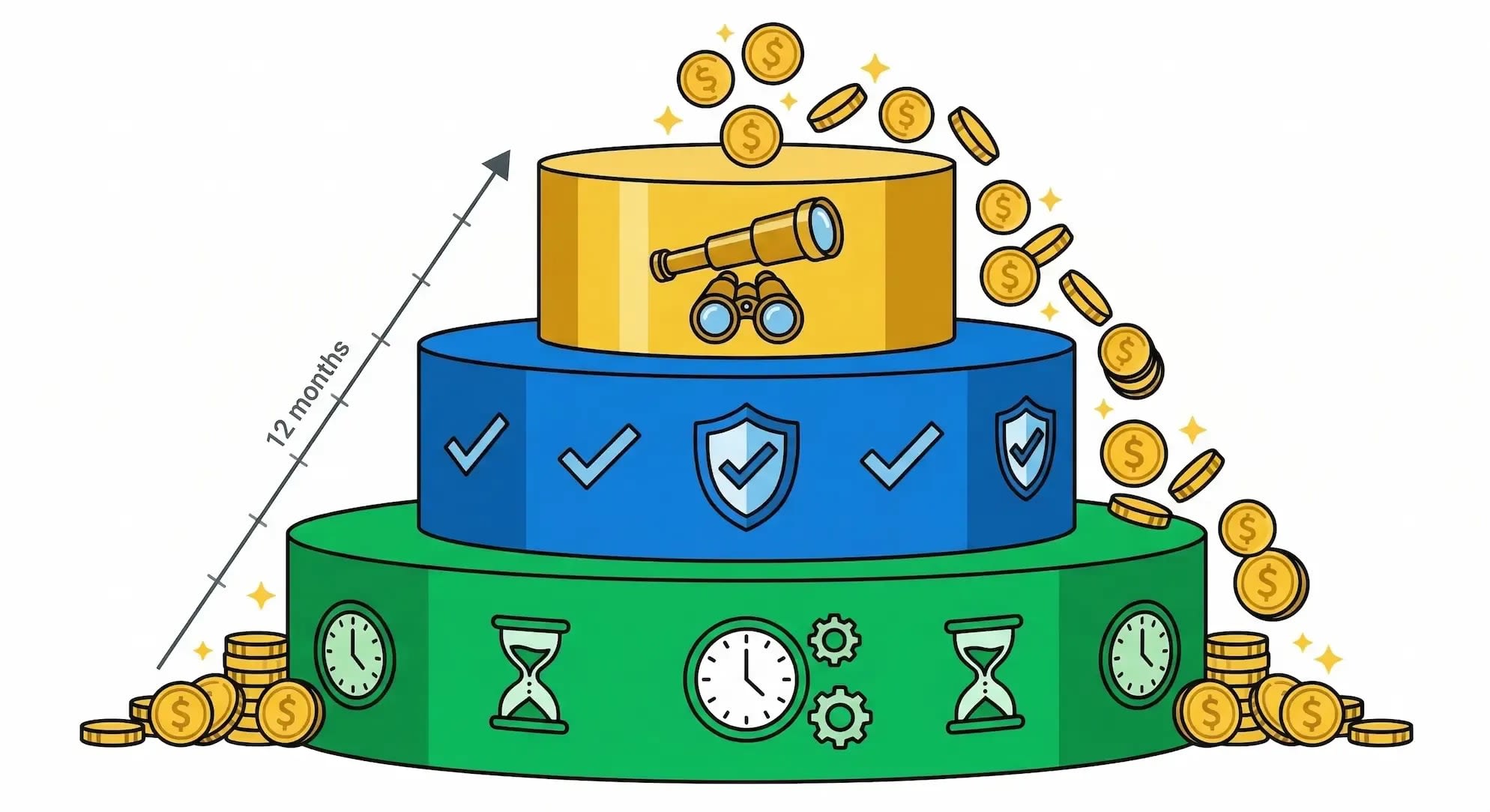
The 3-Tier Model for Calculating AI Apprenticeship ROI
Not all returns arrive at once. They build in layers as the apprentice progresses from simple automations to strategic capability. Think of it in three tiers.
Tier 1: Efficiency Gains (Months 1 to 3)
This is where quick wins live. The apprentice identifies a manual process, builds an automation, and frees up hours every week.
The formula is straightforward:
(Manual time minus automated time) × frequency × hourly cost = annual value
A weekly client report that takes 3 to 4 hours by hand? Automated, it takes 20 minutes. That single workflow saves over £10,000 a year in labour value. In month one.
Tier 2: Quality Uplift (Months 4 to 8)
Efficiency saves time. Quality saves money. Tier 2 is where error reduction and consistency improvement start compounding.
Automated data validation catches mistakes at the point of entry, not three weeks later when someone notices the numbers do not add up. Standardised workflows reduce variation between team members. The person who does it differently every time? Their process now runs the same way as everyone else's.
Quality improvements typically deliver two to three times the ROI of efficiency gains alone. Errors are expensive. Fixing them is more expensive. Explaining them to clients is the most expensive of all.
Tier 3: Strategic Capability (Months 8 to 12+)
This tier is harder to quantify but often the most valuable. It answers one question: what can your team do now that it could not do before?
Automated client communications that go out on time, every time. Real time dashboards that replace quarterly retrospective reports. AI assisted decision support that turns data into action instead of into a slide deck nobody reads.
This is where compound returns begin. The team is not just doing existing work faster. It is doing new work that was previously impossible or impractical.
Worked Example: A 50 Person Professional Services Firm
Numbers are more convincing than adjectives. Here is what the three-tier model looks like in practice.
Efficiency gain
• Process: Weekly client reporting
• Before: 4 hours per week manually
• After: 20 minutes per week
• Annual value: £10,400
Quality improvement
• Process: Data validation on client records
• Before: 15 errors per month taking around 2 hours each to fix
• After: Automated validation at point of entry
• Annual value: £18,000
Strategic capability
• Process: Real time dashboard for client management
• Before: Quarterly retrospective reports
• After: Proactive daily visibility for management
Total measurable annual return: £28,400
And the automations do not stop running when the programme ends. They keep delivering value every week, every month. The workflow built in month 3 is still saving hours in month 36.
These are not one-off gains. They compound.
The 5 Question Audit
Before calculating the return on an AI apprenticeship, you first need to identify the processes worth automating.
Start with these five questions.
1. What report takes longest to produce each week or month?
Reports built from multiple data sources are prime automation targets. If someone spends half a day pulling numbers from four systems into one spreadsheet, that is a workflow waiting to be built.
2. Where does your team enter the same data into more than one system?
Duplicate data entry creates duplicate errors. Integrations between systems such as CRM and finance platforms eliminate both wasted time and inconsistency.
3. Which client communication is essentially copy and paste with minor changes?
Templated emails, onboarding sequences, and status updates are ideal automation candidates.
4. What compliance or regulatory task consumes the most time?
Compliance processes are repetitive by nature. Automated checks and reminders can significantly reduce manual workload.
5. Where do handoffs between people create delays?
Every handoff creates risk. Automated notifications and task routing keep processes moving smoothly.

What to Measure and When
A 12-month programme needs a 12-month measurement plan.
At 3 months
First automations are live. Measure hours saved each week and early team adoption.
At 6 months
Process coverage expands. Track number of workflows running, error reduction rates, and system integrations.
At 12 months
Calculate cumulative time saved, costs avoided, and new capabilities developed.
By this point the apprentice will be preparing for end point assessment with a portfolio of real workplace automations delivering measurable business value.
To understand the full structure of the programme, you can read our guide to the ST1512 AI and Automation Practitioner Apprenticeship.
Hidden Returns Employers Often Miss
The measurable gains are only part of the picture.
Staff retention
Industry benchmarks show 93 percent post programme retention. Employees prefer interesting work to repetitive work.
Internal capability
Each automation built internally reduces reliance on external consultants.
Speed to market
Automated processes adapt to new business requirements in minutes rather than weeks.
Compounding returns
Automations continue delivering value long after the apprenticeship ends.
Research from CMI and Oxford Economics found an average 44.3% return on investment for management apprenticeships, showing the wider economic value of structured training programmes.
The Cost of Not Training
UK labour productivity sits around 15 to 20% below US levels according to OECD data.
Meanwhile, the UK government's 2025 AI Labour Market Survey found that 97% of businesses report at least one AI related skills gap.
If your team is copying data between spreadsheets every Monday morning, they are not building character. They are repeating the same work every week.
The question is not whether organisations will invest in AI capability. It is whether they do so now while funding support is available.
Next Steps
We are currently developing an interactive ROI calculator. In the meantime, a short discovery conversation often provides clearer answers.
During a 30-minute discussion we will:
• identify the highest value automation opportunities in your organisation
• estimate the potential ROI using the three-tier model
• confirm whether the AI apprenticeship programme is a good fit
The funding solves the cost question.
This conversation helps you understand the return.
Frequently Asked Questions
Calculate the Real ROI of an AI Apprenticeship
Discover how the AI and Automation Practitioner Apprenticeship can help your organisation automate processes, reduce manual work, and build real AI capability inside your team. Speak with Solveway to explore how the programme could deliver measurable value for your business.